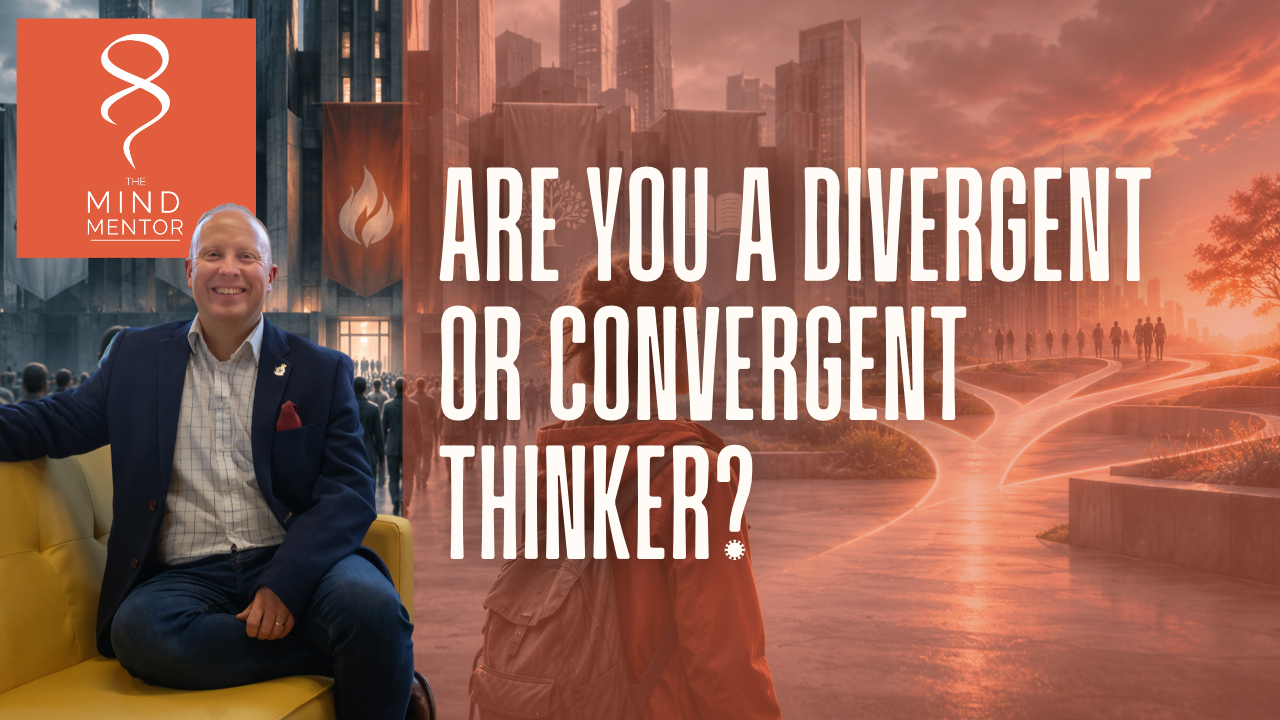
Are You a Divergent or Convergent Thinker
What if the reason you sometimes feel like an outsider isn't because there's something wrong with you, but because the way you think doesn't always fit the expectations of the people around you?
When trying to connect leaves you feeling more alone
I want to share something uncomfortable. For some, what I'm about to describe might be difficult to understand. For others, I suspect it will feel painfully familiar.
Imagine discovering something fascinating. Perhaps you've recognised a connection, questioned something you've always believed or suddenly seen a familiar situation from a completely different perspective.
You're excited. Not because you think you're clever or have all the answers, but because you've discovered something interesting, and naturally, you want to share it.
You want to connect with another human being, explore the idea together and experience that wonderful feeling of mutual curiosity. So you open your mouth, and the response is the complete opposite of what you hoped for.
Silence.
Perhaps someone's expression changes.
Perhaps they look uncomfortable, or the conversation simply stops.
Suddenly, your excitement disappears.
You feel foolish, exposed and disconnected.
An experience that began with a desire for human connection has somehow left you feeling more alone.
This has been a familiar experience throughout much of my life. I'm comfortable with who I am. I genuinely enjoy people, value honesty and love exploring different perspectives.
Yet I've often felt that something about the way I see the world makes connecting with others surprisingly difficult, and there's something much harder to share.
At one point in my life, that repeated sense of disconnection, alongside other painful experiences, contributed to me reaching a point where I wanted to end my life, and this is even more uncomfortable, that thought still often enters my mind.
If that last sentence makes you feel uncomfortable, maybe this illustrates the point, my relationship with suicidal ideation is not negative, because I have learnt what it actually is, a marker to delve deeper into killing the construct of my belief system, not killing the self.
It's the primary driver to my work, wrestling with the why behind the what.
I don't share that for sympathy. I share it because I wonder how many people recognise that feeling of being surrounded by others yet rarely feeling truly understood, and more over just want to escape the pain of rejection, or caring the mask of pretense.
What if some of our loneliness isn't about struggling to connect with people, but about struggling to find people who connect in the way we do?
Why one of my favourite films is Divergent
If you've watched it, you'll remember a society divided into five factions, each representing a particular human quality.
People are expected to fit into an established category, follow its values and fulfil their role in society. But some people don't fit.
They're known as Divergents.
They possess qualities that cross the established boundaries, making them difficult for the authorities to categorise and control, and rather than recognising their differences as something valuable, those in power see them as a threat.
Not because they're necessarily dangerous, but because they don't fit a system built around conformity.
Now, this is fiction, and the film's definition of Divergent is different from divergent thinking in psychology, but how far from fiction is that film and the series of books created by Veronica Roth, and can it give an insight into why so many feel so disconnected today.
Have we created a world that struggles with different thinking?
We often celebrate individuality, creativity, innovation and the freedom to express ourselves. Yet what happens when somebody expresses an opinion that challenges our beliefs?
What happens when someone questions an established way of doing things?
Do we become curious?
Do we explore their perspective?
Or do we immediately begin defending our own?
Do we genuinely value people who think differently, or only when their different thinking agrees with what we already believe?
Think about how much of our lives is shaped by expectations.
From childhood, we're taught what to learn, how to behave, how to demonstrate understanding and what success should look like.
In the workplace, we have procedures, policies, qualifications and established ways of doing things.
Even in our social lives, there are often unspoken expectations about what we should believe, how we should behave and which opinions are acceptable.
Much of this structure exists for good reasons. But sometimes I wonder whether we've become so comfortable with what we know, that we've forgotten how to explore what we don't.
Look at conversations today, particularly online.
How often does somebody offer a different perspective only for the discussion to become an argument about who's right?
How often do we confuse questioning an idea with attacking the person who believes it?
And how often do people stop sharing their thoughts because they've learnt that expressing them creates conflict rather than connection?
Perhaps one of our greatest challenges isn't that we think differently, but that we've forgotten how to be curious about those differences, and this is where understanding how we think becomes interesting.
Divergent and convergent thinking: Which feels more like you?
Psychology recognises two important processes involved in thinking and problem-solving.
Divergent thinking explores possibilities.
You might naturally question things, recognise connections between seemingly unrelated ideas or enjoy looking at a situation from several different perspectives.
You might find yourself asking:
"What if there's another way?"
"Why do we do things like this?"
"What haven't we considered?"
For someone who enjoys divergent thinking, the excitement often comes from exploration rather than immediately finding an answer.
Convergent thinking seeks clarity and solutions.
You might naturally enjoy understanding how things work, examining information and identifying the most effective way forward.
You might ask:
"What evidence supports this?"
"How do we know this is correct?"
"What's the best solution?"
For someone who enjoys convergent thinking, the satisfaction may come from making sense of information and reaching a sound conclusion, and here's something important.
Neither is better. We all use both ways of thinking.
One helps us explore possibilities. The other helps us evaluate them.
But we may naturally feel more comfortable with one approach in particular situations, and that difference might influence more than how we solve problems.
It might also influence how we experience human connection.
When curiosity feels like criticism
Imagine two people having a conversation.
One shares something they believe to be true.
The other responds:
"That's interesting, but what if we looked at it another way?"
To one person, that's an invitation to explore.
To the other, it might sound like a challenge to their knowledge or experience.
They begin defending their position.
The first person feels their curiosity has been rejected.
The second feels their understanding has been questioned.
Neither intended to cause discomfort.
Now imagine the reverse.
Someone has carefully researched a subject and wants to share what they've discovered.
The other person immediately introduces several new possibilities without engaging with the evidence.
The person who did the research might feel dismissed.
Both people wanted to connect. Both may leave feeling misunderstood.
It's not necessarily that one person is right and the other wrong.
It's that they came into the conversation looking for different things.
I've recognised this in my own life.
When I'm around creative people who enjoy exploring possibilities, I often feel much more at home.
There's a freedom to question things, suggest unusual ideas and explore without needing to reach an immediate conclusion.
But I've also learnt that not everybody experiences conversation that way, and understanding that has helped me reconsider something I've struggled with for years.
When people don't engage with my perspective, it doesn't automatically mean they're rejecting me, but my experience makes it feel like they are.
The reality is they may simply be approaching the conversation differently.
What about personality tests?
Many of us have completed personality assessments such as Myers-Briggs, DISC or the Big Five.
These can offer insights into our behaviours, preferences and personalities, although they differ in their scientific foundations. But they don't directly establish whether we're divergent or convergent thinkers.
Psychologists do have specific ways of studying these thinking processes, but they're not fixed personality categories, and perhaps another label isn't what we need.
Perhaps we simply need to recognise how our minds naturally approach the world, and what that means for how we connect with others.
So let's explore that.
Three questions: How do you naturally think?
These aren't a psychological assessment. They're simply three questions to help you recognise what feels natural to you.
Choose the response that best describes your instinctive preference.
1. When you discover something interesting, what excites you most?
A. The possibilities it opens up, the connections you recognise and the other questions it makes you want to explore.
B. Understanding how it works, what the evidence tells you and how that knowledge could be useful.
2. When someone shares a different opinion, what interests you most?
A. Exploring their perspective and discovering whether it opens up another way of understanding something.
B. Understanding their reasoning, examining the evidence and discovering which explanation makes the most sense.
3. When working with other people, when do you feel most engaged?
A. When ideas are flowing freely, people are questioning assumptions and nobody is afraid to explore possibilities.
B. When people are working together to make sense of information, solve problems and achieve something meaningful.
What do your answers suggest?
Mostly A — You may favour divergent thinking.
You enjoy possibilities, exploring ideas, making connections and questioning established assumptions.
Mostly B — You may favour convergent thinking.
You enjoy clarity, evaluating information, understanding how things work and identifying effective solutions.
A mixture — You may enjoy both approaches.
You recognise value in exploration and evaluation, depending on the situation.
Remember, these are preferences to reflect on, not fixed identities or measures of intelligence.
But now I want you to consider something more important.
When do you feel most connected to other people?
Is it when someone is willing to explore an idea with you?
When somebody takes the time to engage with your reasoning?
Or simply when you feel comfortable expressing your thoughts without worrying how they'll be received?
Because perhaps understanding how we think can help us understand why some conversations leave us energised, while others leave us feeling so alone.
Could the way you think contribute to loneliness?
Loneliness isn't simply about being physically alone.
You can have friends, family, colleagues and a busy social life, yet still experience a profound sense of disconnection.
One established understanding of loneliness is the gap between the relationships we want and the relationships we feel we have, and perhaps the way we experience conversation plays a part in that.
For someone who loves exploring ideas, meaningful connection might come through curiosity, imagination and shared discovery.
For someone who enjoys evaluating ideas, meaningful connection might come through thoughtful discussion, shared understanding and working towards something together.
Neither is better.
But imagine spending years feeling that the way you naturally connect with people is rarely reciprocated.
You offer a thought.
Nobody engages.
You share an exciting discovery.
The conversation stops.
You attempt to explore something meaningful, only to feel that you've made somebody uncomfortable.
Eventually, you might begin sharing less, because the judgement, shame, guilt feel so heavy, you don't need to validate who you are but somehow you make the disconnection worse by over explaining.
You've learnt to associate expressing yourself with feeling disconnected, and perhaps one of the loneliest experiences isn't having nobody to talk to.
It's feeling that nobody wants to engage with the things that matter to you.
That doesn't mean divergent thinkers are inherently lonelier than convergent thinkers. Research hasn't established that.
But it does raise an interesting possibility.
Could differences in the way we think, communicate and experience connection help explain why some of us feel misunderstood?
And could recognising those differences help us change that experience?
Understand. Choose. Change.
This is where I believe understanding ourselves becomes so important.
Understand.
Begin recognising how you naturally approach thinking, conversation and connection.
Understand that other people may experience those same situations differently, and recognise that silence, disagreement or a lack of engagement doesn't automatically mean rejection.
Choose.
Choose to become curious about those differences.
Rather than assuming somebody doesn't understand you, consider how they might be experiencing the conversation, and give yourself permission to seek relationships and environments where the kind of connection you value is welcomed.
Change.
Begin creating opportunities for more meaningful connection.
Not by changing who you are, suppressing your curiosity or abandoning the way you think.
But by recognising that genuine connection sometimes requires us to understand how another person's mind approaches the world.
Perhaps being different was never the problem
One of the reasons I love Divergent is that it reminds me how easily society can become uncomfortable with people who don't fit established expectations.
But perhaps the lesson isn't that divergent thinkers are somehow special or that convergent thinkers are resistant to change.
Perhaps it's something much more human.
We all want to feel understood, but we don't always recognise that other people may experience understanding differently.
I've spent much of my life wondering why something that feels so natural to me, sharing curiosity, exploring possibilities and connecting with others, has sometimes left me feeling so disconnected.
I don't have all the answers.
But recognising how differently people may approach thinking has helped me consider those experiences from another perspective, and sometimes, understanding something differently is enough to give us a new choice.
Maybe we don't need everybody to think like us.
Maybe we need to become more willing to understand ourselves first.
Because perhaps the answer to loneliness isn't always finding more people.
Perhaps it's finding ourself and then people who are willing to think with you, even when they see the world differently.
So I'd love to leave you with one question.
Have you ever felt lonely, not because you were alone, but because nobody seemed to understand the way your mind works?
I'd genuinely love to hear your experience.
Marcus


