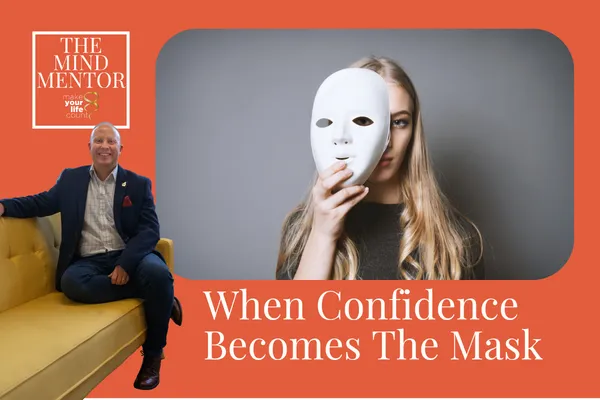
Overcoming Self-Doubt: Embrace Authentic Confidence, Take Off The Mask
Self-doubt, Authenticity, Language Influence, Professional Confidence, AI Communication, Emotional Awareness
The Biggest Challenge: Taking Off the Mask in a World That Rewards Confidence
For many high-functioning professionals, the real work is not learning how to look confident. It is understanding why the person who appears calm, capable and in control can feel something very different beneath the surface.
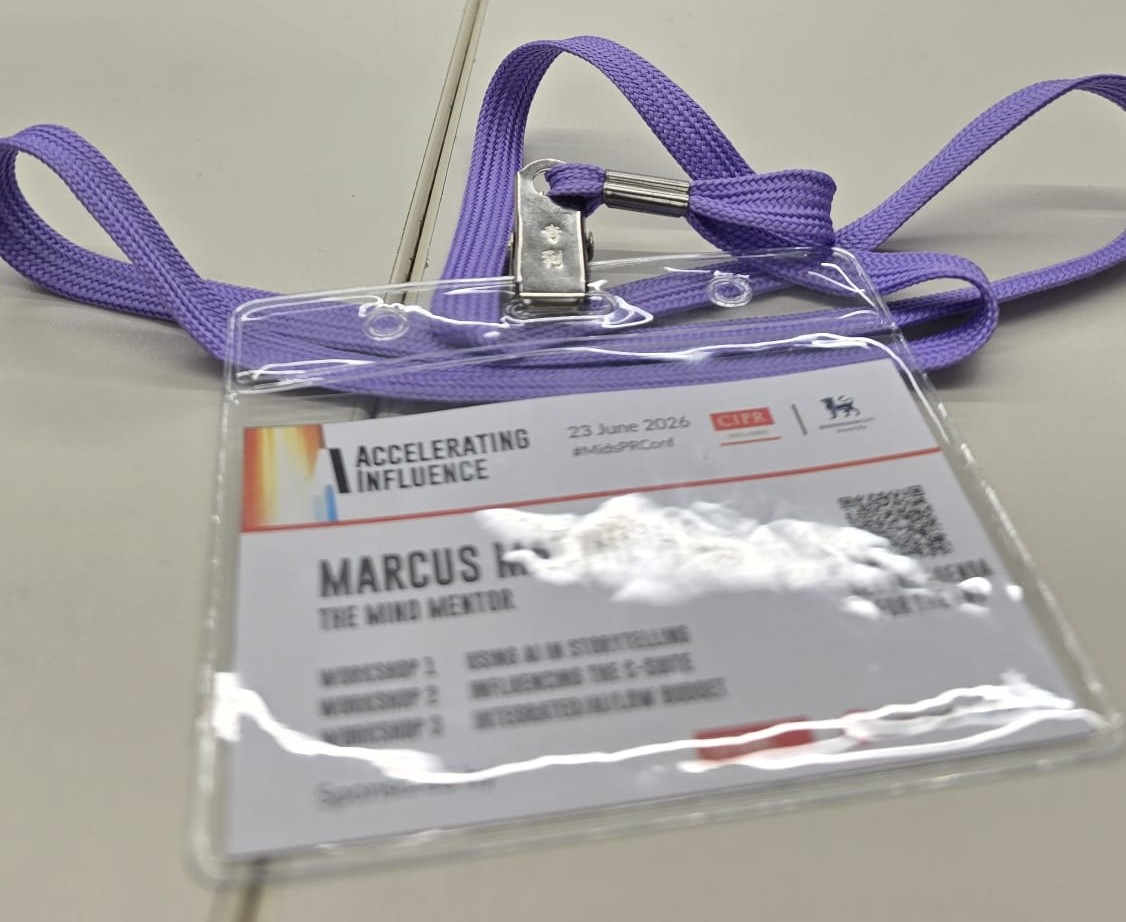
The CIPR Midlands Talk: Confidence on Stage, Questions Inside
Recently, I spoke at a CIPR Midlands event, a room full of seasoned communications professionals who understand better than most how language shapes perception. On the surface, it was a familiar scene: slides prepared, notes in order, confident delivery. I talked about language, influence, trust and AI, how the words we choose can build credibility, shift behaviour and create connection in a world where technology amplifies every message we send.
But I tested this from the start. I invited the listeners to stand, and shout "We Love Marcus", no one did. This wasn't an exercise in vanity, although a loud response would have been lovely. Most stood there, eager to get back on their laptops, or just eager for this crazy Mind guy to finish his talk so they could get back to the comfort of talking PR stratergy and AI. Was that true? What it peception? Will I ever know?
From the outside, it looked straightforward, this wasn't my first talk, and I knew the subject well, but.....
Before that talk, in a room where no one knew me I honestly asked myself:
Have I done enough preparation?
Will this land with a room of experts?
What if they can see the gaps I’m still working on?
I know I checked the spelling but these people read copy like hawks follow prey.
Outwardly, I was calm.
Inwardly, there was a familiar mix of focus, pressure and a subtle thread of self-doubt.
Was I testing the room, or testing myself, or maybe I was somewhere inbetween.
“I Am Confident” and “I Am Behind” – Two Stories, One Person
One insight became impossible to ignore, an unintentional consequence of the unknown environment I was to speak in.
The sentence “I am confident” and the sentence “I am behind” can both describe the same person, on the same day, in the same role.
The difference is not the external performance; it is the internal response those words trigger.
When you tell yourself “I am confident”, your body often softens. Breathing slows. You access experience, judgment and presence. When you tell yourself “I am behind”, the system tightens. Shoulders lift, jaw clenches, the mind races to catch up. The task in front of you may be identical, yet the internal state you bring to it is completely different, and so is the cost to your energy, health and long-term performance.
At CIPR Midlands, I could feel both. The part of me that knows my craft, trusts the material and enjoys speaking, and the part that quietly whispered, “You should be further ahead by now. Others are doing more. Don’t let them see you hesitate.”
The mask of confidence was not false; it was just incomplete. It did not show the pressure, fear of not being enough and the old pattern of needing to prove I deserved to be in the room.
But here is the thing, that conflict is not true, but it is part of an old safety system that needs to be kept in check. I can share this with confidence, because anyone who doesn't feel a little anxious, well doesn't care.
I deeply care about what I do and that was the simple reframe. How can I be confident enough to care enough to invite people to care enough about themselves. It was a risk, did it work, hopefully.
The mask of competence often hides the tension of feeling secretly behind.
The Hidden Cost of Managing Perception as a Leader
This is not just a personal quirk; it is a wider professional problem. Many leaders, founders and senior professionals spend their days managing perception with teams, boards, clients, investors and the wider market. You are expected to be composed, decisive and certain, even when the reality is complex and the path ahead is unclear.
Privately, a different story often runs:
“I should know more.”
“I can’t let them see I’m unsure.”
“If I slow down, everything might fall apart.”
The result is a growing gap between how you appear and how you actually feel.
Over time, that gap can create exhaustion, disconnection and a quiet erosion of self-trust.
💡 Pro Tip: The problem is rarely that you lack capability. It is that your internal language keeps pulling you into a state where your capability is harder to access. By the way I share this as a truth, but I also know that if you care about your work this happens, but I took the mask off along time ago, so I write this blog to show true vulnerability.
Where AI Fits – And Where It Never Will
At the CIPR Midlands talk, we explored how AI amplifies communication. It can draft messages, refine tone, analyse sentiment and help you reach more people, more quickly. For busy professionals, that can feel like a lifeline. But there is a quiet risk: if your inner state is driven by anxiety, comparison or self-doubt, AI simply helps you broadcast that pattern more efficiently.
AI can support clarity, consistency and scale, but it cannot replace authenticity, emotional awareness, judgment, trust or human connection. It cannot feel the tightening in your chest before a board meeting. It cannot notice the way your voice shifts when you move from genuine conviction to rehearsed certainty. It cannot tell you why the person who looks confident on LinkedIn still lies awake at 3am wondering whether they are about to be found out.
This is where the real work of The Mind Mentor lives: not in polishing the external message, but in understanding and resolving the pattern beneath it so that your Professional Confidence is not a mask you strain to hold, but a state you can genuinely inhabit.
When I spoke I took a risk, but I would prefer to turn up and be disliked, than turn up and be fake.
That cost can be great, but it can also be an oppotunity to invite others to show up more confidnetly as themsleves.
Taking Off the Mask: An Invitation
If any part of this feels uncomfortably familiar, the polished exterior, the private pressure, the sense of being both “confident” and “behind” at the same time – you are exactly who the upcoming Taking Off the Mask webinar is for.
During this session, we will explore:
Why capable professionals can look composed while feeling overwhelmed, stuck or disconnected inside.
How your internal language quietly shapes your nervous system, performance and sense of self.
Practical ways to align your outer confidence with genuine inner stability and Emotional Awareness.
You do not need to have the language for what is wrong before you attend. You simply need to recognise that although you appear to be managing, something beneath the surface is asking for your attention. That is often the first sign that it is time to stop adjusting the mask and start understanding the person underneath it.
Your Next Step: Clarity Before Change
At The Mind Mentor, the aim is not to keep you functioning behind the mask. It is to help you understand why it is there, what it has been protecting and how to move forward without needing it in the same way. That begins with clarity, not more pressure to perform.
If you recognise yourself in this, consider two simple steps:
Join the Taking Off the Mask webinar to understand why your external confidence and internal experience may not match – and what that mismatch is really telling you.
You do not have to keep carrying the weight of a confidence that only exists on the outside.
Watch The Webinar