
Unmasking 'I'm Fine': Emotional Honesty in Professionals
Mental Health, Emotional Honesty, The Mind Mentor
I'm Fine: The Two Words We Say When We're Anything But
For many high-functioning professionals, “I’m fine” has become a carefully polished mask. This article explores what sits beneath those two words, and why a simple question “What do you need?” can be the beginning of genuine change.
The polished answer that hides the real story
You know how to hold things together. You can walk into a meeting, deliver a presentation, reassure your team and answer every question with calm, measured confidence. So when someone asks how you are, “I’m fine” arrives automatically, smooth, convincing and well-practised.
Yet if you pause for a moment after saying it, you may notice a quiet discomfort. A sense that you have just stepped a little further away from yourself. Because beneath “I’m fine” there might be exhaustion, confusion, resentment, anxiety, or a growing sense that something in your life no longer fits, even if you cannot yet name what it is.
For many of the people, this is the starting point: outward success, inner unease, and a life that looks right on paper but no longer feels right to live. “I’m fine” becomes less of an answer and more of a shield.
Why “I’m fine” feels safer than being honest
On the surface, “I’m fine” sounds neutral, harmless, even polite. But for capable, responsible people, it often carries a deeper logic:
If I admit something is wrong, I might need to explain it, fix it, or risk looking as though I am not in control, and that isn't a risk I am willing to take.
When you are the person others rely on, the idea of not being okay can feel almost threatening to your identity.
Over time, this can create a subtle split. There is the version of you the world sees - composed, effective, “fine”, and the quiet reality you carry in private. You may still function, still perform, still deliver. But the cost shows up in other ways: disturbed sleep, irritability, emotional numbness, overthinking, anxiety or a constant hum of tension in the background of your day. You certainly don't have the time, nor the energy to explain something you don't fully understand and you also don't want a diagnosis, you want to understand, why do I feel this way, fix it and move forward, but that's not the way the world presents therapy and coaching so you say "I'm fine", and that's justified.
📌 Key Takeaway: “I’m fine” often protects your image of being capable, but it can slowly disconnect you from what you actually feel, need and want.
The quiet power of asking: “What do you need?”
There is a simple question that can begin to loosen the grip of “I’m fine”: “What do you need?”
It sounds almost too small to matter, yet for someone used to solving problems for everyone else, it can be deeply unfamiliar. You might be fluent in asking what your team needs, what your business needs, what your family needs, but rarely pause to ask it of yourself with the same seriousness.
“What do you need?” is not an invitation to justify your feelings or produce a perfectly reasoned plan. It is an invitation to notice. To listen to the information your mind and body have been quietly communicating through stress, fatigue, or that vague sense of disconnection you keep pushing aside because there is always something more urgent to handle first.
Often, the first honest answer is simple and human: “I need rest.” “I need to stop pretending this doesn’t bother me.” “I need clarity on why I feel this way.”
You do not have to know the full solution before you are allowed to acknowledge the need. In fact, the first step is gaining clarit before change: understanding what is happening beneath the surface is the first step towards any meaningful shift.
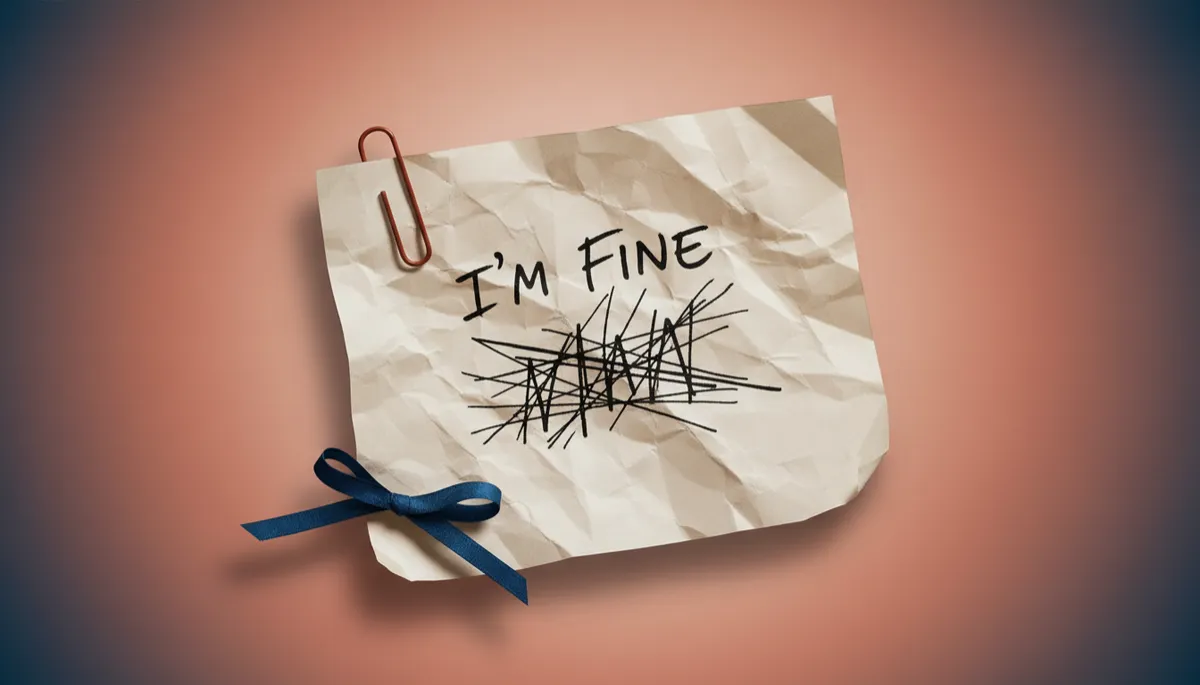
Pausing to ask what you truly need can be the first honest step forward.
Feeling beneath the words you say out loud
One useful way to work with “I’m fine” is to treat it as a signal rather than a verdict. The next time you hear yourself say it in a meeting, at home, or even in your own thoughts, you might quietly follow it with a private question: “If I wasn’t fine, what might I be feeling?” There is no need to perform this for anyone else; the honesty is first and foremost with yourself.
You may notice patterns. Perhaps “I’m fine” appears whenever you feel disappointed but do not want to cause friction, or when your boundaries are crossed but you feel guilty about saying no. Maybe it's when success brings less satisfaction than it used to, and you are not sure what would feel meaningful instead. Each of these moments is less about weakness and more about information, your system signalling that something needs attention.
💡 Top Tip: Replace automatic “I’m fine” with a brief internal check-in: “What do I need, honestly, in this moment?”
You do not have to act on it immediately, but you do need to hear it and feel it.
Moving from coping to understanding and then to change
Many high-performing people have learned to cope impressively well. You can push through tiredness, override doubt and carry on functioning long after something inside you has started to protest. Coping keeps things moving, but it rarely resolves the underlying pattern.
At some point, the cost of “I’m fine” becomes harder to ignore than the fear of being honest.
It's not about labelling, diagnosing or repeating the same story over and over. It is about helping you understand why you feel the way you do, what is really driving the pattern, and what you specifically need in order to feel calm, confident and in control again. “What do you need?” becomes a practical question we can explore together, not a vague idea you are left to solve alone.
When you are not fine and that is your turning point
You do not have to wait until everything falls apart before you are allowed to say, “I’m not fine.” Often, the most meaningful change begins when you notice the quieter signals: the Sunday night dread, the loss of enthusiasm, the way you feel strangely detached from a life you worked hard to build. These are not signs that you are broken; they are signs that something important is asking to be understood.
If you recognise yourself in this, you do not need to have a perfect explanation before reaching out. Many clients begin with a simple admission: “I look as though I’m fine, but I know something needs to change.”
From there, the work is about clarity, not judgement, understanding what sits beneath the surface, and finding a personalised way forward that fits who you are, not who you think you are supposed to be, this isn't about talking about problems, it's about finding the root to the pattern keeping you stuck and moving forward.
A gentle invitation to your next step
If you are tired of saying “I’m fine” while knowing you are not, this might be the moment to ask yourself, with honesty and without pressure: What do you need?
More space? Clearer boundaries? Different goals? To move forward?
Maybe it's way to calm your system so you can think clearly again?
Maybe it's deeper understanding.
You do not need to have the full answer before you ask for support. If something within you is quietly saying, “This cannot carry on as it is,” that is enough.
If this blog awakened a truth inside that you have been denying, you can book a free clarity call to explore what may be happening beneath the surface and consider the right next step for you, with discretion, honesty and a focus on practical, personalised solutions rather than endless coping.
Be honest, deep down are you telling yourself......
Something needs to change, but you don't know how, let me show you.
Book your free clarity call and move beyond “I’m fine” to a life that genuinely feels like your own again, and I promise that change is possible when you understand how your individual mind actually works, because The Mind Mentor measures success by how quickly you know longer need us, so you can be assured your life will move in the right direction.
Speak soon Marcus